
CBSE Class 12 Maths Chapter-wise Weightage and Study Plan (2026–27)
Which chapters carry the most marks? It is the first thing most Class 12 students want to know, and it is a fair question. You have school tests, maybe JEE or CUET coaching running alongside, and a syllabus that feels longer every week. Nobody wants to spend three weeks on a chapter that brings in a couple of marks.
So let’s settle it properly. Below you will find the official unit-wise marks from the CBSE syllabus for 2026–27, what CBSE actually means when it says there is no chapter-wise weightage, which topics you can safely stop worrying about, and a month-by-month plan you can start this week.
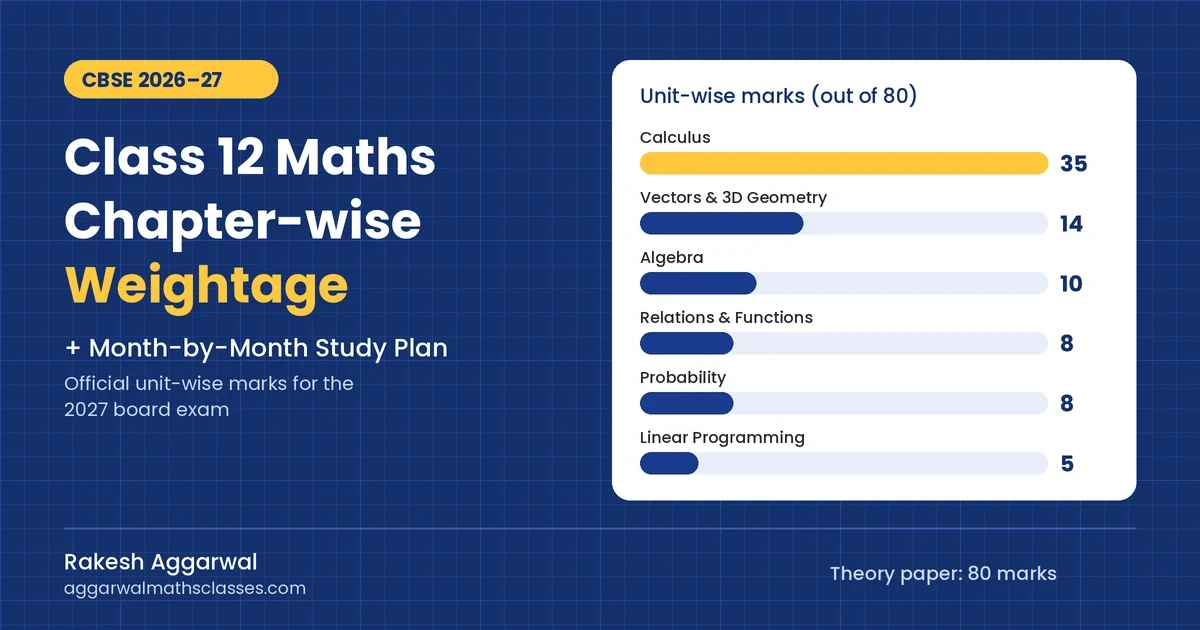
| Quick answer CBSE Class 12 Maths (Code 041) has an 80-mark theory paper and 20 marks of internal assessment. The unit-wise theory marks for 2026–27 are: Relations and Functions: 8 | Algebra: 10 | Calculus: 35 | Vectors and 3D Geometry: 14 | Linear Programming: 5 | Probability: 8 CBSE does not assign marks to individual chapters. Calculus alone accounts for 35 of the 80 theory marks. |
Unit-wise marks for CBSE Class 12 Maths 2026–27
These figures come straight from the CBSE senior secondary curriculum document for 2026–27. The paper is three hours long.
| Unit | Chapters | Marks |
| I. Relations and Functions | Relations and Functions; Inverse Trigonometric Functions | 8 |
| II. Algebra | Matrices; Determinants | 10 |
| III. Calculus | Continuity and Differentiability; Application of Derivatives; Integrals; Application of Integrals; Differential Equations | 35 |
| IV. Vectors and 3D Geometry | Vectors; Three-dimensional Geometry | 14 |
| V. Linear Programming | Linear Programming | 5 |
| VI. Probability | Probability | 8 |
| Total | 13 chapters | 80 |
Two numbers are worth remembering. Calculus is 35 marks, a little under half the paper. Add Vectors and 3D Geometry and you reach 49 marks, which is more than 60% of the theory paper from just seven chapters.
Source: CBSE Mathematics syllabus (Code 041), 2026–27.
Why there is no official chapter-wise weightage
The syllabus document says it in plain words: there is no chapter-wise weightage, and care should be taken to cover all chapters. CBSE fixes marks for each unit, not for each chapter inside it.
So when a website tells you “Integrals: 12 marks” or “Differential Equations: 6 marks”, that is someone’s estimate based on old papers. It is not a CBSE figure, and the split inside a unit can change from one year to the next. If you plan your preparation around those guesses and skip a chapter, you are taking a real risk.
A better way to read the numbers
Divide each unit’s marks by the number of chapters in it. This gives you the average marks per chapter. It is simple arithmetic on the official figures, not an official split, but it tells you a lot about where your hours pay off.
| Chapter(s) | Unit marks ÷ chapters | Average marks per chapter |
| Probability | 8 ÷ 1 | 8 |
| Each Calculus chapter | 35 ÷ 5 | 7 |
| Vectors / 3D Geometry | 14 ÷ 2 | 7 |
| Linear Programming | 5 ÷ 1 | 5 |
| Matrices / Determinants | 10 ÷ 2 | 5 |
| Relations and Functions / Inverse Trigonometric Functions | 8 ÷ 2 | 4 |
Look at the top row. Probability is a single chapter carrying 8 marks, yet it is the chapter many students leave for the last few weeks. Linear Programming is similar: one short chapter, a fixed method, 5 marks. Both give an excellent return for the time they take.
Chapter priority list for 2026–27
Priority here is based on marks, length and how much practice each chapter needs to become reliable. Every chapter still has to be covered.
Master these first
- Integrals. The heaviest chapter in terms of practice. Work on substitution, partial fractions and integration by parts, every standard form listed in the syllabus, and the properties of definite integrals.
- Continuity and Differentiability. Chain rule, implicit functions, logarithmic differentiation, parametric forms and second-order derivatives. Speed here makes the rest of calculus easier.
- Application of Derivatives. Rate of change, increasing and decreasing functions, and maxima and minima. Expect real-life word problems, so practise setting up the function, not just differentiating it.
- Vectors and 3D Geometry. Dot and cross products, direction cosines and ratios, equations of a line in vector and Cartesian form, skew lines and shortest distance. The question types repeat a lot, which makes this a dependable 14 marks.
- Probability. Conditional probability, the multiplication theorem, independent events, total probability and Bayes’ theorem.
Steady scorers
- Matrices and Determinants. Matrix operations, adjoint and inverse (up to 3×3), area of a triangle, and solving a system of equations using the inverse of a matrix.
- Differential Equations. Order and degree, variable separable, homogeneous equations, and linear equations of both types: dy/dx + Py = Q and dx/dy + Px = Q.
- Application of Integrals. Area under simple curves only: lines, circles, parabolas and ellipses in standard form. Draw the figure every time.
- Linear Programming. Graphical method with up to three non-trivial constraints, bounded and unbounded feasible regions.
Short, but never skip
- Relations and Functions. Reflexive, symmetric, transitive and equivalence relations; one-one and onto functions.
- Inverse Trigonometric Functions. Domain, range, principal value branch and graphs. Small chapter, easy 1 and 2 markers.
Topics you can stop worrying about
Many older reference books, question banks and even some websites still carry topics that are not in the 2026–27 Class 12 syllabus. Going by the official syllabus text, these are not listed:
- Equations of planes. The 3D Geometry chapter covers lines only.
- Scalar triple product. The Vectors chapter covers dot and cross products.
- Random variables and binomial distribution. The Probability unit ends at Bayes’ theorem.
- Composition of functions and binary operations in the Class 12 Relations and Functions chapter.
If your book has these, skip them for the board exam. JEE aspirants should still study planes and the triple product, because the entrance exam syllabus is different. When in doubt, check the chapter against the official PDF linked above.
How the question paper is set
CBSE’s question paper design for 2026–27 splits the 80 marks by the kind of thinking each question needs:
| Type of question | Marks | Share |
| Remembering and understanding | 44 | 55% |
| Applying | 20 | 25% |
| Analysing, evaluating and creating | 16 | 20% |
There is no overall choice in the paper, but 33% internal choice is given across all sections.
In the most recent official sample paper (2025–26 session), the paper had five sections:
| Section | Questions | Marks |
| A | 18 MCQs + 2 Assertion-Reason (1 mark each) | 20 |
| B | 5 very short answer (2 marks each) | 10 |
| C | 6 short answer (3 marks each) | 18 |
| D | 4 long answer (5 marks each) | 20 |
| E | 3 case-based (4 marks each) | 12 |
At the time of writing, CBSE had not yet published the 2026–27 sample paper. We will update this section once it is out on cbseacademic.nic.in.
What does this mean for you? More than half the paper tests whether you know your NCERT concepts well and can use them without hesitation. That part rewards regular practice more than brilliance. The last 20% is where a 90 becomes a 95 or more, and that comes from solving unfamiliar, multi-step and case-based questions under time pressure.
Don’t ignore the 20 internal assessment marks
Internal assessment is handled by your school and is split like this:
- Periodic tests: 10 marks. Three tests are suggested across the year (around July–August, November and December–January). The best two are averaged.
- Mathematics activities: 10 marks. You perform 10 activities from the NCERT Lab Manual. Your activity record carries 5 marks, a year-end activity test 3 marks, and the viva 2 marks.
These are the most controllable 20 marks you have. Keep your activity file updated as you go instead of rushing it in January, and prepare for the viva as seriously as you would for a short test.
Month-by-month study plan: September 2026 to the board exam
This plan assumes you are partway through the syllabus in school. Adjust the months if your school follows a different order, but keep the sequence: finish calculus early, then move to the shorter units, then practise full papers.
September
Finish and tighten Relations and Functions, Inverse Trigonometric Functions, Matrices and Determinants. Start Continuity and Differentiability. Begin a formula notebook, one page per chapter, and add to it every day.
October
Complete Continuity and Differentiability and Application of Derivatives. Start indefinite integrals. From now until the exam, do a 15-minute warm-up of 8 to 10 integrals or derivatives every day.
November
Definite integrals and their properties, Application of Integrals and Differential Equations. Your mid-term or half-yearly exam usually falls around here. Treat it as a calculus check and note every mistake.
December
Vectors, 3D Geometry, Linear Programming and Probability. Finish your first full revision of the syllabus by the end of the month, and complete your lab activities and record.
January
Move to full papers. Start with the official CBSE sample paper, then previous years’ board papers. Aim for two timed three-hour papers a week and keep an error log: the question, what went wrong, and the correct method. Pre-boards usually happen in this window.
February until the exam
Write full papers at the same time of day as your board exam. Revise from your formula notebook and error log, not from new books. Give extra attention to Section E case-based questions and to presentation in 5-mark answers.
Starting late?
If you are beginning serious preparation with about 12 weeks left, study in this order: core calculus (Integrals, Continuity and Differentiability, Application of Derivatives), then Vectors and 3D Geometry, Probability, Linear Programming, Matrices and Determinants, Differential Equations and Application of Integrals, and finally Relations and Functions with Inverse Trigonometric Functions. Stick to NCERT, NCERT Exemplar and past papers. Our guide on how to score 90 in CBSE Maths has more on the final weeks.
A simple weekly routine
- Five days: one new topic, plus 20 to 30 minutes revising something from an earlier week.
- One day: a timed test of 25 to 40 marks on that week’s topics.
- One day: go through your error log, redo the questions you got wrong, and rest.
Consistency beats long weekend sessions. Maths is a practice subject, and two hours every day will take you further than eight hours on a Sunday.
Mistakes that quietly cost marks
- Skipping steps. CBSE awards marks step by step. A correct final answer with missing working can still lose marks.
- Forgetting the small things. The constant of integration, the domain in inverse trigonometric questions, units in word problems.
- Weak LPP graphs. Label the axes and corner points, shade the feasible region clearly, and check whether the region is unbounded before stating a maximum or minimum.
- Mixing direction ratios and direction cosines in 3D questions.
- Not defining events before applying Bayes’ theorem. Write E1, E2 and A clearly first.
- Leaving case-based questions for the end. They carry 12 marks and need calm reading. Decide your section order during practice, not on exam day.
- Using outdated material with topics that are no longer in the syllabus.
Need help with a difficult chapter?
If calculus or 3D Geometry still feels shaky by November, a few focused sessions can save you weeks of struggle. Rakesh Aggarwal teaches Class 12 Maths for CBSE, ISC and JEE students, online across India and offline in Delhi NCR, with regular tests and doubt-solving built into every batch.
Book a free trial class and bring the chapter that is troubling you most. We will start there.
Frequently asked questions
What is the weightage of Calculus in CBSE Class 12 Maths 2026–27?
Calculus carries 35 of the 80 theory marks. It includes five chapters: Continuity and Differentiability, Application of Derivatives, Integrals, Application of Integrals and Differential Equations.
Does CBSE give chapter-wise weightage for Class 12 Maths?
No. CBSE gives unit-wise marks only and asks students to cover all chapters. Chapter-wise figures you see online are estimates based on past papers.
Which chapters are the quickest to score in?
Linear Programming, Matrices and Determinants, and Vectors are usually considered quick to score because the methods are fixed and the question types repeat. Probability is also worth prioritising because one chapter carries 8 marks.
Is equations of planes in the Class 12 Maths syllabus for 2026–27?
No. The Three-dimensional Geometry chapter in the 2026–27 syllabus covers lines only. JEE aspirants should still study planes for the entrance exam.
How many marks is the internal assessment in Class 12 Maths?
Internal assessment is 20 marks: 10 for periodic tests (best two of three) and 10 for mathematics activities from the NCERT Lab Manual.
Are calculators allowed in the CBSE Class 12 Maths exam?
No. All calculations are done by hand, so practise arithmetic speed along with concepts.