
How to Improve Maths Problem-Solving Skills for JEE
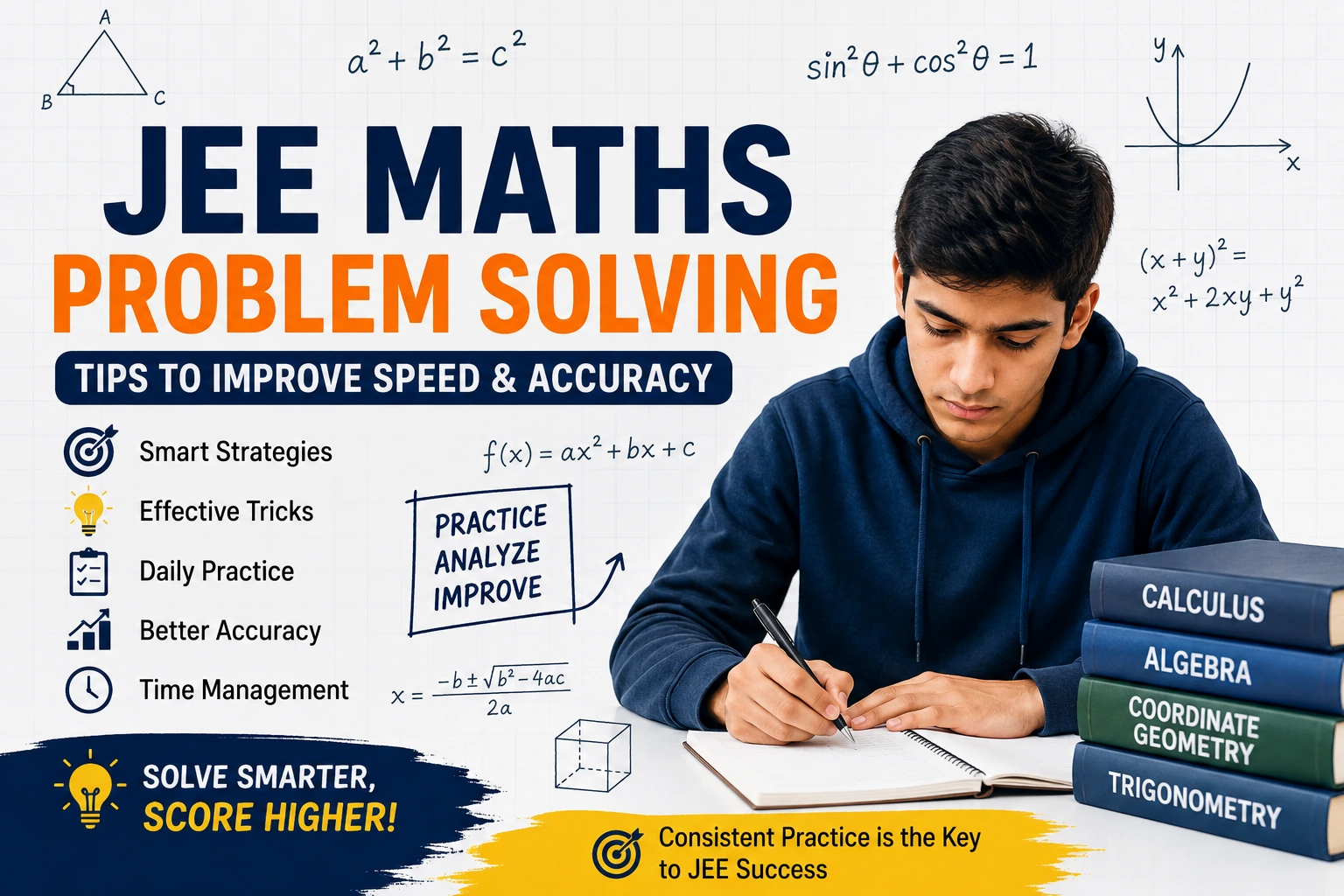
You may understand a Maths chapter well, remember most of the formulas and even follow every example taught in class. But when a new JEE question appears in front of you, you may still wonder, “Where do I start?”
This is one of the most common problems among JEE aspirants.
The reason is simple: understanding Mathematics and solving unfamiliar Mathematics problems are two different skills.
JEE Maths does not only test whether you remember a formula. It tests whether you can identify the right concept, connect different ideas, choose an efficient approach and complete the calculation accurately.
The good news is that problem-solving is a skill. And like every skill, it becomes better with the right kind of practice.
If you are wondering how to improve Maths problem-solving skills for JEE, this guide will help you build a practical approach that you can follow throughout your preparation.
Why Do Students Struggle With JEE Maths Problems?
Students often assume that they are weak in Mathematics because they cannot solve difficult JEE questions. That is not always the real problem.
In many cases, students struggle because they:
- Memorise formulas without understanding their applications
- Solve only familiar questions
- Look at solutions too quickly
- Do not analyse their mistakes
- Practise chapters separately for too long
- Spend too much time on one difficult question
- Do not revise older concepts regularly
JEE Mathematics requires more than completing the syllabus. You need to train your mind to recognise patterns and connect concepts quickly.
1. Build Concepts Before Learning Shortcuts
Shortcuts can save time, but they work only when you understand the concept behind them.
Suppose you memorise a shortcut for a particular type of quadratic equation. It may work perfectly when the question looks familiar. But the moment JEE changes the format slightly, the shortcut may become useless.
That is why your preparation should normally follow this order:
Concept → Standard Problems → Different Variations → PYQs → Timed Practice
Before leaving a chapter, ask yourself:
- Why does this formula work?
- When should I use it?
- When should I not use it?
- Can the same problem be solved using another method?
- What changes if one condition in the question changes?
Thinking this way develops mathematical flexibility.
2. Stop Counting Questions and Start Analysing Them
“I solved 100 questions today” sounds impressive, but the number itself does not tell you how much you improved.
Solving 30 questions carefully can sometimes be more useful than rushing through 100.
After solving a good problem, spend a few seconds asking:
What was the key idea in this question?
For example:
- Was there an identity hidden in the expression?
- Did a graph make the problem easier?
- Was substitution the key?
- Did symmetry reduce the calculation?
- Was there unnecessary information in the question?
This habit gradually helps you recognise similar patterns in unfamiliar questions.
3. Give Yourself Time Before Checking the Solution
Many students make this mistake:
Question looks difficult → try for two minutes → open the solution.
Doing this repeatedly trains you to understand solutions, not to discover them.
When you are practising, spend some genuine time with a difficult question.
Try:
- Writing down what is given
- Identifying the chapter or concepts involved
- Drawing a diagram or graph where applicable
- Testing a simpler case
- Recalling a related standard result
- Trying an alternative representation
Even if you cannot solve the question completely, the struggle itself improves your problem-solving ability.
After seeing the solution, close it and solve the complete question again independently.
That final step is important.
4. Maintain a JEE Maths Error Notebook
Your mistakes are one of your best preparation resources.
Keep a separate notebook or digital document containing questions where you made mistakes.
Divide errors into categories such as:
Conceptual Error: You did not understand which concept was required.
Formula Error: You remembered or applied a formula incorrectly.
Calculation Error: The method was correct but the arithmetic went wrong.
Approach Error: You chose a long or unsuitable method.
Reading Error: You missed an important condition in the question.
Time-Management Error: You spent too much time on one problem.
Do not simply write the correct answer.
Write one short line:
“Why did I get this wrong?”
Reviewing this notebook once or twice every week can prevent the same mistakes from appearing repeatedly in mock tests.
5. Practise Questions in Levels
Do not start every new chapter with the hardest JEE Advanced questions you can find.
Use progressive difficulty.
Level 1: Concept-Based Questions
These confirm whether you understand the basic concept and formula application.
Level 2: Standard JEE Problems
These teach common applications and combinations.
Level 3: Mixed and Multi-Concept Questions
Here you begin connecting two or more ideas.
Level 4: JEE Main and JEE Advanced PYQs
Previous-year questions help you understand how concepts are actually tested.
Moving gradually from basic to advanced problems builds confidence and prevents unnecessary frustration.
6. Use Previous-Year Questions Properly
PYQs should not be treated like another exercise book.
They should be analysed.
After completing a chapter, solve relevant JEE previous-year questions and observe:
- Which concepts appear repeatedly?
- What type of manipulation is commonly required?
- Which questions took you too long?
- Which concepts are frequently combined?
- What type of mistakes are you making?
Mark questions that teach you an important technique and revisit them during revision.
The goal is not to memorise PYQs. The goal is to understand the thinking behind them.
7. Learn to Recognise Patterns
Strong Maths students do not necessarily perform every calculation faster. Often, they simply recognise the structure of the question earlier.
For example, expressions such as:
x + 1/x
should immediately make you think about identities involving:
x² + 1/x²
Similarly:
- A symmetric definite integral should make you check for substitution properties.
- A quadratic with roots α and β should make you think about relationships between sum and product of roots.
- A complicated coordinate geometry question may become easier through slope, distance or vector interpretation.
Pattern recognition develops through repeated exposure and thoughtful practice.
8. Solve the Same Question in More Than One Way
Whenever you come across a good JEE Maths question, ask whether another solution is possible.
A problem may be solved using:
- Algebra
- Graphs
- Calculus
- Geometry
- Trigonometric identities
- Substitution
- Symmetry
You do not have to find multiple solutions for every question. But doing it occasionally trains you to see Mathematics from different angles.
This becomes particularly useful when your first method during the examination becomes too lengthy.
9. Improve Calculation Speed Separately
Sometimes students know exactly how to solve a question but lose time in calculation.
Practise basic manipulation regularly:
- Fractions
- Squares and cubes
- Factorisation
- Algebraic identities
- Trigonometric values
- Logarithmic properties
- Standard derivatives
- Standard integrations
The purpose is not to perform calculations blindly. It is to reduce the mental load of basic operations so that you can focus more attention on the actual problem.
10. Start Mixed-Chapter Practice
Chapter-wise practice is necessary when learning.
But JEE will not tell you which chapter to use before every question.
Once you have completed a reasonable portion of the syllabus, start solving mixed sets.
For example, a practice session could contain questions from:
- Calculus
- Coordinate Geometry
- Algebra
- Vectors and 3D
- Probability
Now your brain must perform an additional task: identify the correct concept before solving the problem.
That is much closer to actual exam-style thinking.
11. Use the 3-Round Method During Timed Practice
One useful way to approach a Maths practice paper is to divide questions mentally into three rounds.
Round 1 – Direct Questions
Attempt questions where you immediately understand the approach.
Round 2 – Think-and-Solve Questions
Return to questions that need some manipulation or deeper thinking.
Round 3 – Difficult or Lengthy Questions
Attempt these only after securing the questions you were already confident about.
This prevents one difficult question from consuming valuable time.
3 JEE Maths Questions With Quick Problem-Solving Tricks
Here are three simple examples showing how recognising patterns can reduce unnecessary calculation.
Question 1
If:
x + 1/x = 3
find:
x² + 1/x²
Solution
Instead of solving for x, square the given expression:
(x + 1/x)² = x² + 1/x² + 2
Therefore:
9 = x² + 1/x² + 2
So:
x² + 1/x² = 7
Trick
When you see expressions involving x + 1/x, first check whether standard identities can give the required expression directly.
Do not calculate x unless the question actually requires it.
Question 2
If α and β are the roots of:
x² − 5x + 6 = 0
find:
α² + β²
Solution
From the quadratic equation:
α + β = 5
αβ = 6
Now:
α² + β² = (α + β)² − 2αβ
= 25 − 12
= 13
Trick
If a question asks about an expression involving the roots of a quadratic equation, first check whether it can be written using α + β and αβ.
Finding individual roots may be unnecessary.
Question 3
Evaluate:
∫₀^(π/2) [sin x / (sin x + cos x)] dx
Solution
Let:
I = ∫₀^(π/2) sin x / (sin x + cos x) dx
Using the substitution:
x → π/2 − x
we get:
I = ∫₀^(π/2) cos x / (sin x + cos x) dx
Adding the two forms:
2I = ∫₀^(π/2) 1 dx
2I = π/2
Therefore:
I = π/4
Trick
Before doing lengthy integration, check whether the limits and function have symmetry.
For definite integrals over limits such as 0 to π/2, symmetry can often reduce the entire problem to a few lines.
A Practical Daily Routine to Improve JEE Maths
You do not need to solve Maths continuously for six or seven hours to improve.
Consistency matters more.
A student can structure a focused Maths session like this:
20 minutes: Revise formulas and previous mistakes
45 minutes: Learn or revise one concept
60–90 minutes: Solve selected problems
30 minutes: Solve PYQs or mixed questions
15 minutes: Analyse mistakes and update the error notebook
The exact duration can change depending on your schedule.
What matters is that every session includes learning, solving, and reviewing.
What Should You Do When You Cannot Solve a JEE Maths Question?
Use this simple sequence:
Step 1: Read the question again slowly.
Step 2: Write down all known information.
Step 3: Identify possible chapters or concepts.
Step 4: Try a standard formula, graph, diagram or substitution.
Step 5: Ask whether the question has symmetry or a hidden identity.
Step 6: If still stuck after a serious attempt, study the solution.
Step 7: Close the solution and solve the question yourself.
Step 8: Solve the same question again after a few days.
If you can reproduce the method later without seeing the answer, you have actually learnt something from the question.
Common Mistakes That Slow Down JEE Maths Improvement
Avoid these habits:
Collecting Too Many Books
One good source solved properly is more valuable than five unfinished books.
Memorising Every Shortcut
Understand the main concept first. Use shortcuts only when you know why they work.
Ignoring Easy Questions
Easy and moderate questions build speed, accuracy and confidence. Do not practise only difficult problems.
Avoiding Weak Chapters
Weak chapters normally remain weak until you deliberately give them attention.
Never Revisiting Solved Questions
Important questions should be revised. A question you solved two months ago may feel completely new if you never reviewed the concept.
Comparing Your Speed With Other Students
Problem-solving speed develops gradually. Focus on whether your accuracy, approach and understanding are improving.
How Rakesh Aggarwal Sir Helps Students Build Strong JEE Maths Problem-Solving Skills
For JEE Mathematics, students often need more than a list of formulas. They need someone who can identify where their thought process is breaking down.
At Aggarwal Maths Classes, Rakesh Aggarwal Sir focuses on concept-based preparation, regular practice, assessments, problem-solving techniques and exam-oriented strategies for students preparing for IIT-JEE.
With more than 18 years of teaching experience, his approach focuses on helping students understand Mathematics step by step rather than depending only on memorised methods.
A student struggling with JEE Maths may need help with different things: one may have weak concepts, another may understand concepts but struggle with applications, while another may lose marks because of speed or calculation mistakes.
Personalised guidance helps identify these individual gaps.
Students can also strengthen their preparation through regular doubt-solving, practice sets and performance analysis so that mistakes are corrected before they become habits.
For students looking for structured guidance, learning from an experienced IIT JEE Maths tutor can make preparation more organised and focused.
Frequently Asked Questions
1. How can I improve my Maths problem-solving skills for JEE?
Start by strengthening your concepts and then practise questions from basic to advanced levels. Solve JEE PYQs, maintain an error notebook and spend time analysing why a particular method works. Mixed-topic tests and timed practice can further improve your ability to recognise the right approach quickly.
2. How many Maths questions should I solve daily for JEE?
There is no perfect number for every student. The quality of practice is more important than simply counting questions. Solve a realistic number of problems that allows you to understand the method, analyse mistakes and revise difficult questions instead of rushing through a large target.
3. Why can I understand JEE Maths solutions but cannot solve questions myself?
This usually happens when you spend more time reading solutions than developing solutions independently. Give yourself enough time to struggle with a question before checking the answer. After studying the solution, close it and solve the complete problem again without help.
conclusion
Improving JEE Maths is not about finding one magical trick.
It comes from repeatedly following a simple cycle:
Learn → Attempt → Struggle → Analyse → Correct → Revise → Attempt Again
Build strong concepts, solve different types of questions, analyse your mistakes and practise under timed conditions.
At first, improvement may seem slow. But as you solve more meaningful problems, you will start recognising patterns faster. Questions that once looked completely unfamiliar will begin reminding you of concepts and approaches you have already practised.
That is when your real JEE Maths problem-solving ability starts developing.
If Mathematics continues to feel confusing despite regular practice, structured guidance from Rakesh Aggarwal Sir at Aggarwal Maths Classes can help you identify weak areas, strengthen concepts and build a more effective JEE Maths preparation strategy.